
Contact Us
To provide feedback on the Community Policing Dispatch, e-mail the editorial board at [email protected].
To obtain details on COPS Office programs, publications, and resources, contact the COPS Office Response Center at 800-421-6770 or [email protected]

U.S. Department of Justice
Office of Community Oriented Policing Services
Washington, DC 20530

How To Stop a Self-Driving Car: Guidance for Interacting with Automatic Driving Systems
September 2025 | Volume 18 | Issue 3
How can a law enforcement officer stop a vehicle for a traffic violation and get the car’s registration information if there is no driver? And if there is a driver, but the automated driving system (ADS) caused the crash, who is at fault?
As the Autonomous Vehicle Industry Association (AVIA) reported in early 2025, if driverless vehicles such as ride-hail cars and delivery trucks have already driven more than 44 million miles on U.S. public roads, these questions pose a growing and serious challenge for law enforcement, Emergency Medical Services (EMS), and fire and rescue personnel.
 To address them, the U.S. Department of Justice Office of Community Oriented Policing Services (COPS Office) partnered with the International Association of Chiefs of Police and the Virginia Tech Transportation Institute (VTTI), a research institute dedicated to solving critical transportation challenges from the vehicular, driver, infrastructure, and environmental perspectives that has been at the forefront of transportation research for more than 35 years.
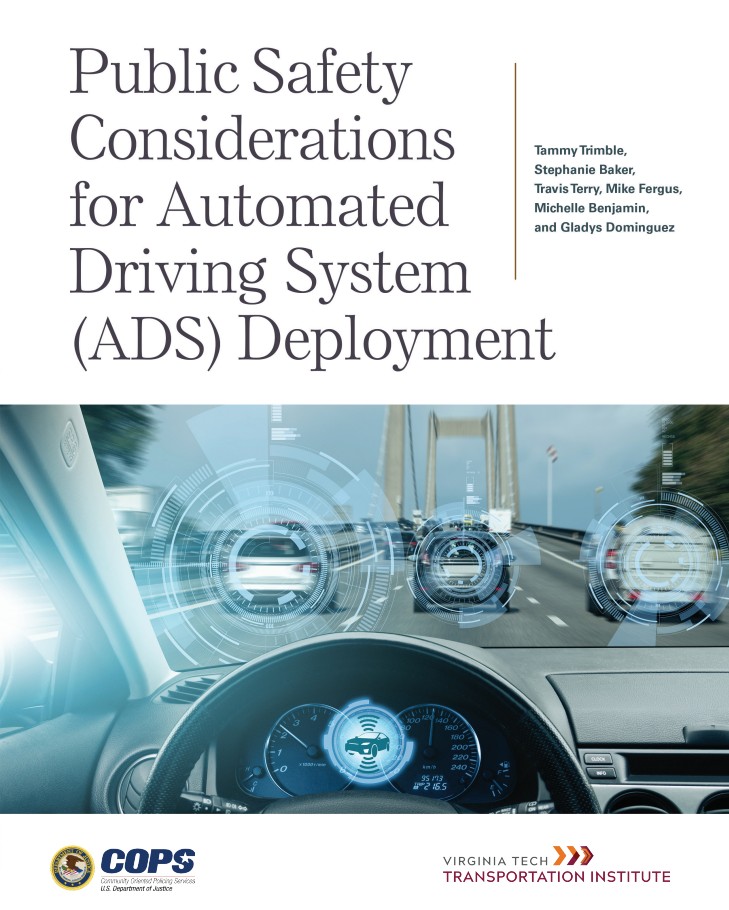
In early 2025, VTTI, the IACP, and the COPS Office published Safety Considerations for Automated Driving Systems (ADS) Deployment, a white paper which outlines the ways law enforcement can safely and effectively interact with partially and fully autonomous vehicles.
Based on extensive research, a survey of 378 members of law enforcement and first responder agencies, and input from focus groups and interviews with subject matter experts (SMEs), this publication discusses best practices for interactions with ADS-dedicated vehicles, which are vehicles that can complete the driving task without human assistance.
As these systems are deployed, police officers and other first responders may interact with ADS-dedicated vehicles in a variety of situations: responding to an emergency, conducting a traffic stop, investigating an abandoned vehicle, conducting traffic direction and control, stabilizing or extricating a vehicle, or securing a crash scene.
Considerations for Direct, Indirect, and Information Interactions
Safety Considerations for Automated Driving Systems (ADS) Deployment discusses best practices for three types of interactions in these situations:
- Direct interactions, such as when a first responder makes physical contact with a vehicle to access its interior to reach a victim;
- Indirect interactions, such as hand signals or other nonverbal communication to direct traffic, sirens alerting surrounding vehicles that an emergency vehicle is coming, and flashing emergency lights indicating that an emergency vehicle is responding to an emergency;
- Informational interactions requiring the exchange of documents with law enforcement, such as the driver’s license or the car’s registration.
The paper presents a summary of scenarios or use cases for interactions such as these, along with the key takeaways which indicate the gaps needing to be addressed between law enforcement and ADS-dedicated vehicle technology developers.
In all cases, the paper stresses that it is critical for first responders to not only be able to immediately identify a vehicle as an ADS-dedicated vehicle, but know how to signal it to stop and ensure the vehicle will remain stationary. Officers must also learn how to acquire documentation or information regarding ownership if the vehicle is driverless.
Awareness of ADS-dedicated vehicle features and understanding how to safely interact with them was also discussed in the white paper’s focus groups, with examples such as determining if the vehicle is electric (which presents a greater shock or fire risk), understanding how to properly disable or park a vehicle to keep a scene safe, and knowing how to interact with it during traffic direction and control.
As one focus group participant commented, “It would be very beneficial as an officer directing traffic to be aware that something is automated and also be at least trained somewhat in what that vehicle may be trying to sense from you. That way, you can communicate with the vehicle systems appropriately.”
Participants also voiced concerns about the ability of vehicles to identify an officer in the roadway and respond appropriately to the officer’s presence and direction. Addressing this, another officer suggested that in the future, traffic direction may require standardized equipment and motions that ADS-dedicated vehicles are capable of responding to.
Focus group participants also wanted clarification of where fault lies in a collision with an ADS-dedicated vehicle. Speaking of liability, a focus group participant said, “I just think that my approach to the scene would be different, because I might gather more evidence … regarding the features of the vehicle, and … what actually caused this crash. Is it human error versus vehicle error?”
In response to these and other knowledge gaps, the white paper identified critical areas for law enforcement and first responder training.
Following the focus groups, seventeen additional online sessions were held with subject matter experts in areas such as crash response, crash reporting, crash reconstruction, and law enforcement training.
Understanding ADS Capabilities and Training to Interact with Them
Among the recommendations resulting from these sessions was that first responders learn how to quickly identify an ADS-dedicated vehicle to determine appropriate actions. Safety was another concern, as participants noted that autonomous vehicles may present hazards unlike those encountered with conventional vehicles, such as electrical power storage, vehicle wiring and routing, fuel tank location, and fuel line locations.
Safety Considerations for Automated Driving Systems (ADS) Deployment includes a table which describes many automated vehicle and connected vehicle technology applications, such as Cooperative Intersection Collision Avoidance Systems, which can reduce crashes at signalized and stop-controlled intersections.
The benefits and challenges of these advances are also discussed. It is noted that vehicles with sensory technology designed to automatically adhere to safety and traffic rules may reduce crashes, 94 percent of which are believed to be caused by human error.
Another benefit would come from ADS-dedicated vehicles which can provide robotaxis and other transportation options for the disabled or elderly populations, while also reducing the need for many Americans to own a car. Additionally, driverless taxis may be especially impactful in reducing collisions caused by driving under the influence (DUI). The supply chain advantages, and possible cost savings of driverless delivery trucks, is also noted. The findings stress the importance of developing first responder interaction strategies through collaboration between industry and law enforcement.
The paper concludes with the message that law enforcement should play a role in developing the governance of ADS-dedicated vehicles, including by advocating with lawmakers, creating frameworks for safety standards and operational guidelines, and developing training for law enforcement.
A list of more than 90 research documents related to first responder interactions with ADS-dedicated vehicles is appended as a resource for developing new procedures, practices, and training,
Subscribe to Email Updates
To sign up for monthly updates or to access your subscriber preferences, please enter your email address in the Subscribe box.


Explore
Connect With Us
Want to stay connected with the COPS office?
Follow us on social media!


