
Contact Us
To provide feedback on the Community Policing Dispatch, e-mail the editorial board at [email protected].
To obtain details on COPS Office programs, publications, and resources, contact the COPS Office Response Center at 800-421-6770 or [email protected]

U.S. Department of Justice
Office of Community Oriented Policing Services
Washington, DC 20530

Vulnerable Person Registry Programs: Reimagining Crisis Response
July 2025 | Volume 18 | Issue 7
What If?
The Colonie Police Department's executive leadership made a simple thought experiment: How could they share institutional knowledge with newer officers about well-known persons in their jurisdiction struggling with their mental health or who have an invisible disability?
They asked themselves the following questions:
- What if we could create a safer environment proactively, before officers are called to respond?
- How can we provide officers with the tools, pre-arrival, that they need to de-escalate situations?
- How can we provide officers with essential information, such as calming methods and triggers, that would allow for a more compassionate and effective response?
- What if police officers, armed with this information, were able to approach mental health calls with greater understanding and empathy?
- Can we simultaneously create a valuable resource for families, enabling them to advocate for their loved ones, share critical information, and build stronger relationships with their local police?
Vulnerable Person Registries
Colonie police leadership’s answer to all of these questions was to create a vulnerable person registry. Vulnerable person registries have been promoted by both the International Association of Chiefs of Police (IACP) and the FBI in Law Enforcement Bulletin.1 In the policing community, use of these registries has focused on the maturing population with Alzheimer’s disease and, to a lesser extent, on individuals with disabilities such as autism.
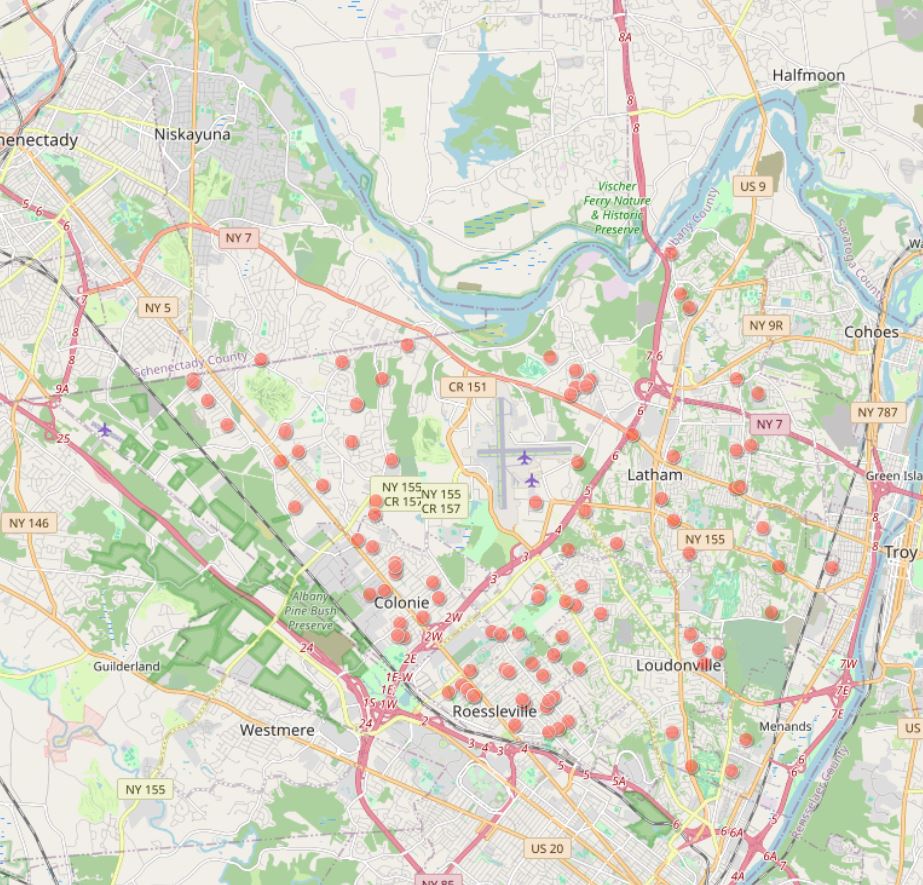
The Town of Colonie used its police department’s existing computer-aided dispatch (CAD) and geographic information system (GIS) systems to make several budget-friendly enhancements to its new registry program. Registry information was integrated into the CAD system, so that any call dispatched to the residence of a person on the registry will alert the dispatcher and the responding officer to triggers that might agitate the vulnerable person and appropriate methods of calming them. Registrants’ homes were also plotted on a GIS map that serves as a visual reminder that there are vulnerable persons living in the area. This feature has shown promising results for disabled individuals who are nonverbal and those who are prone to wander.2Keys to Success - Agency Culture & Community Trust
A little more than a year into the project, the registry has enrolled more than 100 people, and officers have responded to more than 100 calls for service involving these registrants and used the information to generate positive outcomes. The program’s success stems from two sources:
(1) agency culture and (2) a trusting community.
The Colonie Police Department has an established history of community policing efforts. It has been at the forefront of realistic crisis communication training for their officers, adapting principles from the FBI Crisis Negotiations course for everyday patrol use before “de-escalation” ever entered the everyday police lexicon. 3 The agency's commitment to scenario-based training allows its officers to continually use and refine their verbal skills. As a result, officers already had a strong foundation in active listening skills and were primed to become supercommunicators.4 Officers willingly embraced the registry’s calming methods and trigger avoidance, coming to regard them as a cheat code for lightning-fast rapport building.
In some organizations, cultural barriers can work against normalization of these types of community policing efforts. To ensure officers' receptivity to community collaboration, efforts should be gradually incorporated into their everyday activities. Leadership must give such changes continual attention to see them through to institutionalization. Community Trust & PartnershipInvariably, when we have been asked to present on the program, we have seen skepticism and confusion on the faces of more than a few audience members, over the notions both that officers would use registry information in a positive way and that anyone would willingly provide such information to the police. The community trust on which the registry’s success depends did not happen overnight; it was built one relationship at a time. The National Alliance on Mental Illness (NAMI) New York State was a primary stakeholder on the Town of Colonie’s enhancement project. The partnership was developed through a colleague in the mental health field who introduced a NAMI mother (Mary Beth Honsinger, who would later become the organization’s executive director) to one of the Colonie Police Department’s leaders. Honsinger was disappointed with the treatment her son had received from their local police force and embarked on a quest to find a police department that was doing things better. After connecting with the Colonie Police Department, she became convinced that a better police response was in fact possible. Through this partnership, NAMI both supported and promoted the registry’s implementation with its members, providing a needed “stamp of approval” to gain the trust of a hesitant population. It supported Colonie’s efforts for one reason: belief in the police department’s commitment to a culture of care for vulnerable populations.
Keys to Success - CAD and GIS Integration
If agency culture laid the foundation for the registry’s creation, leveraging the existing tools and resources which officers used daily paved the way to its success. Registrant information was made easily accessible for dispatchers through the CAD system’s person and location “be on the lookout” (BOLO) feature. BOLOs have traditionally been used to distribute vitally important information, including through the Mobile data terminals (MDT) used in the field. Using this feature to place registry information at officer’s fingertips communicated the importance of that information.
Similarly, the agency used GIS technology to create a visualization of the data. CAD and MDT maps, already used to plot calls for service, agency vehicles, and fire hydrants, now also have a Vulnerable Person layer. This interactive GIS feature plots the registrant addresses and allows agency members point-and-click access to a registrant’s photograph, interests, triggers, and calming mechanisms. A feature previously used to identify the hose connection for fire departments is now being used by police personnel to make personal connections with the most vulnerable.
Conclusion
While mental health and disability advocates continue to lobby for robust crisis response systems, for the foreseeable future law enforcement will continue to play a critical role. Wise executives know they must find ways to establish community health collaborations and develop systems for handling encounters with those with mental illness or disabilities.5
Empowering families who are worried about encounters with law enforcement to take steps to keep their loved ones safe shows promise in both improving outcomes and building trust between the community and its police department. Developing a vulnerable person registry in your agency with community collaboration is a step in the right direction.
James J. Gerace, Chief of Police, Colonie, New York
Todd H. Weiss, Director, Capital Region Crime Analysis Center, Albany, New York
References
- IACP (International Association of Chiefs of Police), A Guide to Law Enforcement on Voluntary Registry Programs for Vulnerable Populations (Alexandria, VA: International Association of Chiefs of Police, 2017); Keith Stambaugh, “Registries for Persons Prone to Wandering,” Perspective, Law Enforcement Bulletin, February 9, 2023.
- James J. Gerace and Todd H. Weiss, “Enhancing the Capabilities of Vulnerable Person Registries: When CAD and Compassion Converge,” Police Chief, May 29, 2024.
- Gregory M. Vecchi, Vincent B. Van Hasselt, and Stephen J. Romano, “Crisis (Hostage) Negotiation: Current Strategies and Issues in High-Risk Conflict Resolution,” Aggression and Violent Behavior 10, no. 5 (2005), 533–551.
- Charles Duhigg, Supercommunicators: How to Unlock the Secret Language of Connection (New York: Random House, 2024).
- Civil Rights Division, The Civil Rights Division’s Pattern and Practice Police Reform Work: 1994–Present (Washington, DC: U.S. Department of Justice, 2017).
Subscribe to Email Updates
To sign up for monthly updates or to access your subscriber preferences, please enter your email address in the Subscribe box.


Explore
Connect With Us
Want to stay connected with the COPS office?
Follow us on social media!


