
Contact Us
To provide feedback on the Community Policing Dispatch, e-mail the editorial board at [email protected].
To obtain details on COPS Office programs, publications, and resources, contact the COPS Office Response Center at 800-421-6770 or [email protected]

U.S. Department of Justice
Office of Community Oriented Policing Services
Washington, DC 20530

Police and the Media: Best Practices for Positive Interaction at Mass Events
February 2026 | Volume 19 | Issue 2
Whenever and wherever a demonstration or protest occurs, both law enforcement and the media are sure to be present—police to ensure public safety, and members of the media to document the event.
“Police and media have a lot in common,” said Al Baker, Director of Communications for the New York State Unified Court System and former Executive Director of Media Relations at the New York City Police Department. “We both run toward danger. We have to be there and see it to either adjudicate it or report about it correctly. . . . [b]ecause the cornerstone of our democracy is an informed electorate.”
Like police, reporters and photographers perform a public service: keeping people informed. And when an event could endanger the community, the press serves an essential public safety function by providing critical information about it.
Police and media usually interact at protests and demonstrations without any problems, but as such events become chaotic, police may struggle to distinguish between the crowd they are dispersing and reporters who are lawfully there to cover the gathering.
This difficulty was especially notable in 2020, when protests swept the country following the murder of George Floyd by arresting officers in Minneapolis, bringing crowds to the streets of large cities and small towns alike. Law enforcement and members of the media often found themselves in conflict rather than in harmony with one another.
To prevent future misunderstandings and provide practical guidance for positive interactions, the Police Executive Research Forum (PERF) and the Reporters Committee for Freedom of the Press convened a roundtable in Washington, D.C., on October 3, 2023.
With support from the U.S. Department of Justice’s Office of Community Oriented Policing Services (COPS Office), the roundtable brought together approximately 50 representatives of law enforcement and media organizations to discuss working relationships and develop actionable recommendations for both police and members of the media.
Practical, Actionable Recommendations for Police and Media during Demonstrations
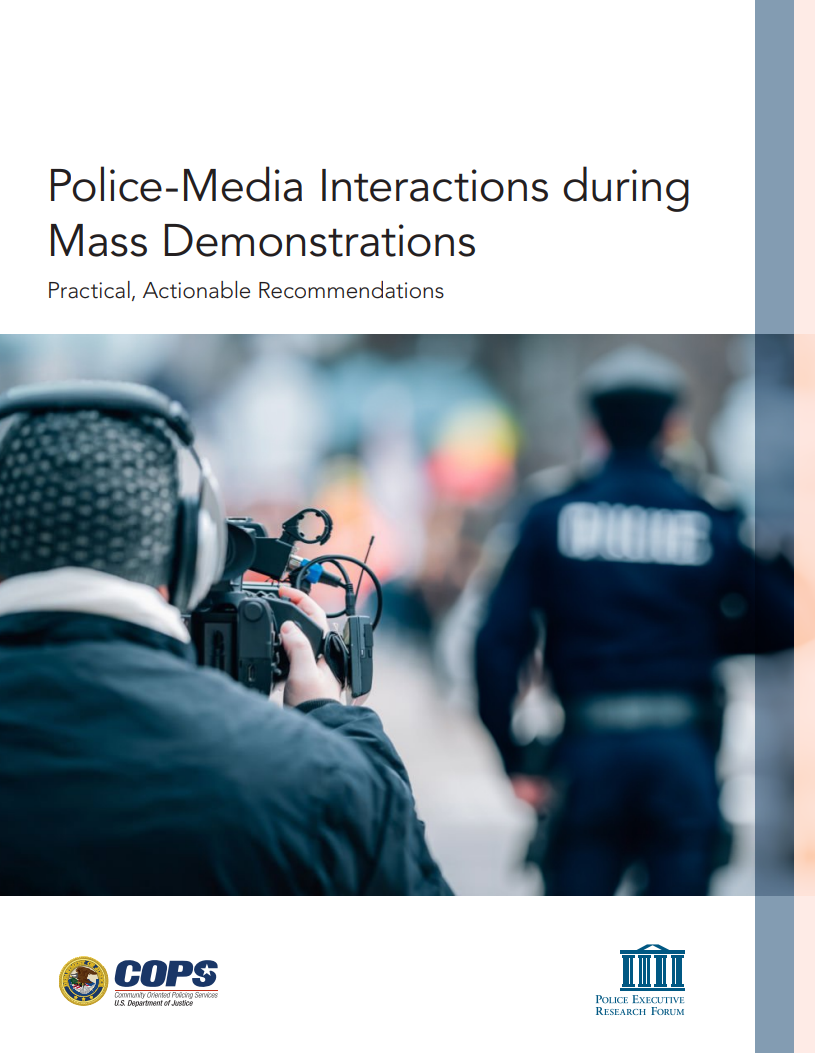 To provide a foundation for these discussions, PERF gathered input prior to the meeting by conducting virtual focus group interviews—two with members of the media, two with police, and one with civil rights organizations. PERF also disseminated a questionnaire.
The present report, Police-Media Interactions during Mass Demonstrations: Practical, Actionable Recommendations, summarizes the findings from the questionnaire, group interviews, and roundtable discussion and provides the detailed, actionable recommendations that resulted.
Practical Guidance for Agencies and News Organizations Large and Small
Though the roundtable discussion primarily addressed interactions between police and journalists affiliated with major news outlets, most of its suggestions apply equally to smaller news organizations, freelancers, and members of the public (sometimes called citizen journalists) whose recordings of police activity often circulate online.
These recommendations lay out guidance for both law enforcement agencies and media before, during, and after mass gatherings. This guidance can help ensure that all present are able to perform their duties safely and successfully.
Who is the Media?
“‘Media’ means any person who is an employee, agent, or independent contractor of any newspaper, magazine or other periodical, book publisher, news agency, wire service, radio or television station or network, cable or satellite station or network, or audio or audiovisual production company, or any entity that is in the regular business of news gathering and disseminating news or information to the public by any means, including, but not limited to print, broadcast, photographic, mechanical, internet, or electronic distribution.”*
*“Interim Policy 14.090 – Crowd Management, Intervention, and Control,” Seattle Police Department Policy Manual (Seattle, WA: Seattle Police Department, 2023), https://public.powerdms.com/Sea4550/documents/2555273.
These recommendations include the following:
- Familiarizing media organizations with the local police agency and its procedures
- Instructing officers in First and Fourth Amendment protections and familiarizing them with news media practices
- Providing journalists with training related to mass demonstrations (and inviting law enforcement to attend)
- Holding pre-event law enforcement briefings for the media
- Establishing a law enforcement point of contact for media during the event
- Providing opportunities for media to present their credentials
- Considering individuals without credentials to be members of the media if they are acting as journalists in function and behavior and not engaging in protest activities
- Requiring supervisory approval before law enforcement charges an individual claiming to be media
- Designating a safe media location
- Establishing protocols for dispersal orders
- Holding after-action reviews
Training and Policy Guidance is Essential for Media and Law Enforcement
To be prepared for these events, officers must be properly trained and given clear policy guidance on interacting with all types of media representatives. Similarly, news outlets can learn ahead of time about some of the law enforcement concerns related to these events so they can provide news coverage while allowing the police to carry out their public safety duties unencumbered.
Managing demonstrations will always present challenges, particularly during rapidly evolving situations. But the guidance readers will find in this report can go a long way toward providing the best outcomes both for the media coverage essential to a well-informed public and for the law enforcement officers responsible for keeping their communities safe.
Subscribe to Email Updates
To sign up for monthly updates or to access your subscriber preferences, please enter your email address in the Subscribe box.


Explore
Connect With Us
Want to stay connected with the COPS office?
Follow us on social media!


