
Contact Us
To provide feedback on the Community Policing Dispatch, e-mail the editorial board at [email protected].
To obtain details on COPS Office programs, publications, and resources, contact the COPS Office Response Center at 800-421-6770 or [email protected]

U.S. Department of Justice
Office of Community Oriented Policing Services
Washington, DC 20530

Ensuring Everyone Gets Home Safe: IACP’s Work on IDD and Dementia
January 2026 | Volume 19 | Issue 1
 According to the Journal of Pediatrics, a 2016 study estimated that 37 percent of children with intellectual or developmental disabilities (IDD), such as autism spectrum disorder (autism) have wandered in the past year. The Alzheimer’s Association estimates that sixty percent of individuals with dementia, such as Alzheimer’s Disease, will wander at some point in their lives.
Wandering is a common behavior in which individuals with IDD or dementia leave a safe location and can potentially end up in a dangerous situation. When that happens, police are often responsible for the search and rescue efforts.
In 2018, the United States (U.S.) Congress enacted Kevin and Avonte’s Law, which supports programs to prevent and reduce the injury and death of individuals with IDD or dementia who wander. The Autism Society of America, in partnership with the International Association of Chiefs of Police (IACP) and The Arc’s National Center on Criminal Justice and Disability, leads the Home Safe project, a national training and technical effort to prevent water- and wandering-related deaths through proactive programming, public awareness, and public policy. Home Safe, which is funded by the Bureau of Justice Assistance (BJA), has provided training and technical assistance to over 70 Kevin and Avonte grant–funded agencies since 2019, along with countless other police and service provider agencies across the United States. The Home Safe project also offers a series of resources to support police efforts to safely reduce injury and death of individuals with IDD or dementia who wander.
Police Resources on Interacting with and Responding to Individuals with IDD
Finding and safely recovering a missing person who has autism or another IDD can present unique challenges for police and caregivers. For police, a wandering incident starts at the point of notification; however, it is important to remember that, for families and caregivers, a wandering incident may have started much earlier. Tips for Caregivers Supporting Children on the Autism Spectrum is a customizable resource for police to share with their communities. This resource provides guidance for caregivers on how to prepare for and respond to wandering incidents. When caregivers call 911, telecommunicators can use a predetermined set of questions to support the gathering of essential information, including the person’s diagnosis, when the individual was last seen, locative technology data, information on direction and means of travel, and any other relevant details. Gathering this information at the point of notification can allow telecommunicators to relay this information to first responders. Home Safe’s Children on the Autism Spectrum: 911 Telecommunicator & Dispatcher Checklist provides a list of essential questions telecommunicators should ask callers who are reporting a missing child. These questions can be further adapted for reports of a missing adult with IDD or dementia.
Education on wandering is paramount to help responders identify behavioral characteristics and warning signs. Home Safe developed Understanding Children on the Autism Spectrum: A Guide for First Responders, an overview for first responders to improve their understanding of the characteristics and behaviors of children with autism, strategies for building awareness through community partnerships, and tips on using technological solutions to locate children who have gone missing. Home Safe’s Children on the Autism Spectrum: Search Protocols & Questionnaire for First Responders provides police with key information and guidance to supplement their search and rescue training. This resource also provides a fillable form to guide responding officers in gathering information from caregivers on the scene. The Autism Society’s Safety on the Spectrum™: Water and Wandering Program offers additional training and free resources addressing water safety for caregivers, autistic individuals, and first responders.
For police, responding to situations involving individuals with IDD in a safe, effective manner can often present significant challenges. The IACP provides training and resources to the policing community about the nature and needs of individuals with IDD and behavioral health conditions, including Mental Health Conditions & Developmental Disabilities, a resource comparing behaviors and characteristics of mental health conditions and developmental disabilities. Developmental Disabilities: What Law Enforcement Officers Need to Know provides possible behaviors of individuals with IDD and tips on ensuring safe and effective interactions. The Home Safe webinar, What Law Enforcement Need to Know About Developmental Disabilities: Tips from an Officer and His Son, also provides officers with strategies for successfully interacting with individuals with IDD. Law Enforcement Response to People with Developmental Disabilities: Steps for Deflection or Pre-Arrest Diversion provides insights into the developmental disability community and outlines options for safe and effective deflection and pre-arrest diversion for individuals with IDD who encounter police and may be experiencing a crisis or need services. Lastly, Crisis Response and Intervention Training (CRIT) is a 40-hour training program designed to prepare officers in their response to individuals experiencing crises related to behavioral health conditions and IDD. CRIT is an off-the-shelf curriculum that can be customized to local needs and is available at no cost.


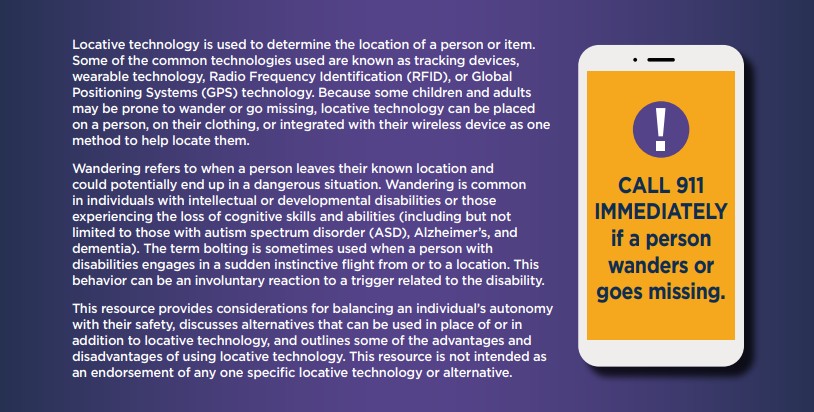
Locative Technology
Locative technology is a tool police and caregivers can use to prevent and respond to wandering incidents. Locative technology can help to find the location of an item or a person through an electronic device. Device selection should be carefully considered by police departments, families, caregivers, and the individuals wearing the technology, when developmentally appropriate. Considering Locative Technology in the Disability Community: Balancing Autonomy and Safety can help guide decision-making processes for families. Home Safe also features a webinar that highlights strategies to address wandering by individuals with IDD, as well as the use of locative technology: in Exploring Locative Technology: What You Need to Know to Address Wandering, a panel of police, family members, and disability advocates discuss lessons learned in using locative technology.
Police Resources on Interacting with and Responding to Individuals with Dementia
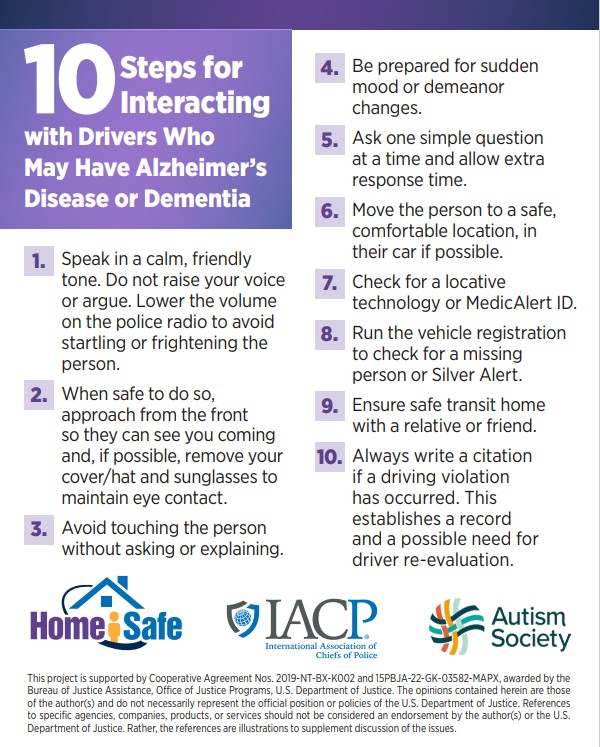 Individuals with dementia who wander are likely to encounter police through different means than individuals with IDD. By 2050, 88 million U.S. residents will be 65 or older, and the Alzheimer’s Association projects that approximately 80 percent of this population will likely be driving. Consequently, police may encounter drivers who, while initially coherent, are subsequently recognized as confused or disoriented. The Senior Drivers: Did You Know? postcard is a useful way to remind officers of some of the signs of unsafe driving and provide them with steps to take when interacting with a senior driver who is exhibiting unsafe driving.
The 10 Warning Signs a Driver May Have Alzheimer’s Disease or Dementia pocket card provides 10 basic warning signs that a driver may have dementia and 10 steps to ensure positive interactions. The Did You Know? postcard provides quick reference points on the Dos and Don’ts of effectively interacting with an individual with dementia.
The Identifying and Evaluating the At-Risk Older Adult evaluation card and the Identifying and Helping a Driver with Alzheimer’s Disease or Dementia brochure contain assessment questions to help police identify and evaluate an at-risk adult’s orientation and memory and include information about what to do when interacting with them.
All these IACP resources are designed to be small enough to be kept in patrol cars and used in the field.
Lastly, the Home Safe project provides a comprehensive overview of promising practices related to implementing communication, technology, and education strategies for wandering prevention, response to wandering, and recovery of individuals with IDD or dementia who have wandered. Promising Practices to Address Wandering of Individuals with Developmental Disabilities or Dementia provides police, service providers, and caregivers with a compilation of information gathered from Kevin and Avonte grant–funded jurisdictions and other subject matter experts across the U.S.
All these resources and more are available on the Home Safe webpage. Email [email protected] for more information. If you are interested in applying for a Kevin and Avonte jurisdictional grant, visit BJA’s Available Funding webpage.
Images courtesy of the International Association of Chiefs of Police (IACP).
Subscribe to Email Updates
To sign up for monthly updates or to access your subscriber preferences, please enter your email address in the Subscribe box.


Explore
Connect With Us
Want to stay connected with the COPS office?
Follow us on social media!


